FG DEBT CLIMBED 658% TO N26.9 TRILLION IN 21 YEARS
Dec 01 2021

Data seen above showed that federal government borrowings (local and foreign debt) climbed from N3.55 trillion in 1999 to N26.91 trillion at the end of March 2021.
This represents a 658 percent increase in 21 years, comprising the administrations of Olusegun Obasanjo, Umar Musa Yar’Adua, Goodluck Jonathan, and the current Muhammadu Buhari.
HOW MUCH BUHARI BORROWED IN 6 YEARS
On external borrowings, President Buhari increased debt from $7.3 billion in 2015 to $28.57 billion as of December 2020. This means that the president incurred $21.27 billion on foreign loans to the country’s debt portfolio.
The country’s exchange rate moved from N197 to a dollar in 2015 to N381 at the end of December 2020.
Analysis of consolidated debt showed that the external debt increased by 291.37 percent while domestic debt grew by 86.31 percent in the last six years of the Buhari government.
Overall, the Buhari-led government has had an accumulated debt of N17.06 trillion as of March 2021, using the N381 exchange rate. This represents a 173.2 percent increase from when he was elected president in 2015.
DEBT PROFILE UNDER JONATHAN’S ADMINISTRATION
At the beginning of former President Goodluck Jonathan’s tenure in 2011, the federal government had an accumulated debt of N6.17 trillion.
Analysis of the debt figure showed that local debt amounted to N5.62 trillion while foreign debt stood at $3.5 billion (about N548.65 billion, using the exchange rate of N156.7/$1).
By the end of 2015, the foreign debt component hit $7.3 billion, while domestic debt increased by N8.4 trillion. The country’s exchange rate also stood at N197/$1.
Overall, the federal government component of the total public debt increased from N6.17 trillion in 2011 to N9.8 trillion in 2015, representing an increase of N3.63 trillion or 58.8 percent.
YAR’ADUA/JONATHAN’S BORROWINGS
Under the Umar Musa Yar’Adua/Goodluck Jonathan-led government between 2007 and 2011, domestic debt of the federal government moved from N2.17 trillion to N5.62 trillion. The foreign component of the debt also increased from $2.11 billion to $3.5 billion within the period.
The country’s exchange rate also moved from N116.8/$1 to N156.7/$1.
The combined debt profile increased from N2.42 trillion to N6.17 trillion in four years, representing a 155 percent jump.
Of the debt figure, Jonathan completed the tenure from May 2010 to May 2011 after the death of Yar’Adua. The period saw a surge in the federal government’s debt from N4.94 trillion to N6.17 trillion. This represents a 24.9 percent increase in one year.
OLUSEGUN OBASANJO’S TENURE
During the tenure of former president Olusegun Obasanjo, the debt level of the federal government reduced from N3.55 trillion in 1999 to N2.42 trillion at the end of 2007.
The 8-year term of Obasanjo resulted in a dip in FG’s local and foreign debt level, representing a 31.8 percent decline.
The country’s exchange rate was between N98.02 to N116.8 to a dollar during the tenure.
Analysis of the figures showed that external debt decreased from $28.04 billion by 1999 to $2.11 billion at the end of 2007. However, the domestic component increased from N798 billion to N2.17 trillion within the same period.
Nigeria abduction epidemic kidnapping in 4 charts
The NST also reported top 7 hotbeds of deaths and abductions in the first half of the year. Share The Kidnap-for-ransom business is fuelling an …
The NST also reported top 7 hotbeds of deaths and abductions in the first half of the year. Share
The Kidnap-for-ransom business is fuelling an abduction epidemic in Nigeria with many persons killed and kidnapped in the first half of 2021.
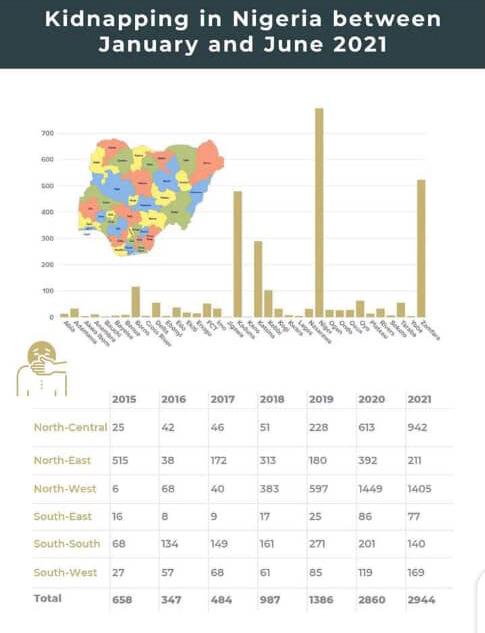
According to data from Nigeria Security Tracker (NST), there have been 2,943 abduction cases and 5800 death cases due to insecurity between January and June 2021.
This means about 16 persons were abducted per day while 32 persons were killed per day within the period. However, these are only cases that were reported, the numbers are probably larger.
Asides from dealing with the economic hardship of rising unemployment, poverty, and inflation, Nigerians have to pay for leaving their houses as huge ransoms are demanded by kidnappers.
According to a report by SB Morgen (SBM) Intelligence, a Lagos-based political risk analysis firm, an estimated N10 billion have been demanded by Kidnappers ($19.96 million) in the first six months of the year.
Nearly 1000 students have been taken from schools in mass abductions since December, according to the United Nations. This means about 33 percent of kidnapped people in the first half of the year are school children.
In the latest wave of mass abductions targeting schoolchildren, gunmen kidnapped 140 students from a boarding school in northwestern Nigeria.
This only adds to the long list of other security troubles in the country, including violence in the north stirred by Fulani herdsmen, bandits, and the scourge of ritual killings in Nigeria.
More people have been kidnapped from the North West
From the data, the six geo-political zones in Nigeria all recorded kidnap or abduction cases within the first six months of the year. The North West had the highest cases with 1,405 persons, 942 in the North Central, 210 in the North East, 169 in the South West, 140 in the South-South, while South East recorded the lowest number of people kidnapped, 77. In total, 2,557 people were abducted in the North and 386 in the South.
Nigeria recorded the most deaths in May
While some Nigerians were lucky to be released after abductions, others did not make it out alive, and others have died due to violence caused by Boko Haram terrorists, Fulani herders and ritualists with 5800 persons were killed in the first six months of the year. This means on average, 32 persons were killed daily within the period.
May recording the highest number of deaths at 1,045, April had 1,032 and June with 1,011. Others are 958, 879 and 875 for January, February and March respectively.
Niger, Zamfara and Kaduna have the most Kidnap cases
The most-reported kidnap cases were recorded in Niger (795), Zamfara (523), Kaduna (479), Katsina (289), Borno (115), Kebbi (103), Oyo (63), Delta (55), Taraba (55), Abuja (52), Edo (37) and Imo (33).
Zamfara recorded 862 deaths and 523 kidnap victims, Borno with 1,137 deaths and 115 kidnap victims, Kaduna had 715 deaths and 479 kidnap victims, Benue had 449 deaths and 9 kidnap victims, Niger had 407 deaths and 795 kidnap victims, Ebonyi had 210 deaths and 5 kidnap victims while Katsina had 164 deaths and 289 kidnap victims.

 Site Title